AI Didn't Unlock Everyone. It Unlocked the Connectors.
My thinking on who AI actually unlocks has evolved. Here's what changed it.
Sol Lipman is a career product leader. Five exits — products at Yahoo, AOL, Ring, Amazon. By his own description, he sits on the less technical end of the PM spectrum.
When he commented on my first article, I wasn’t expecting what he said: “I am on the less technical side. But suddenly I feel like I’m having that Miyagi moment where everything comes together.”
He’s the person my article was about. He’s just not the person I said it was about.
That’s the thing that’s been sitting with me for the past two weeks.
I wrote Article #1 about product managers — my field, my craft.
The thesis was specific: AI unlocks people who’ve spent careers sitting at the seam between technical and human, translating between what engineering can build and what customers need. I called that person a product manager.
The responses told me I had the right thesis and the wrong label.
Sol commented. Then David Robinson (drob), VP of Product Design at Spotnana, someone I worked with at Yahoo, left another line: “Massive unlock for product design too.” Then David Rout, an engineer I used to work with, raised the friction point from the other direction. He was asking the same structural question, just from a different vantage point. He’s not a PM either.
And then Allen Reitter, a former team member at Yahoo who’s now a Senior PM at Microsoft, and attended a builder talk I recently did, posted about it to his own network. He quoted my core thesis back. His words: “We can’t defer our judgment to AI.” Then added: “the real unlock will come from figuring out the right balance between human judgment and AI capability.”
Taste and discernment are still the edge, and what allows these tools to actually move user and business value.
Not one of these people described themselves as a typical PM.
I had the right thesis. I had the wrong label.
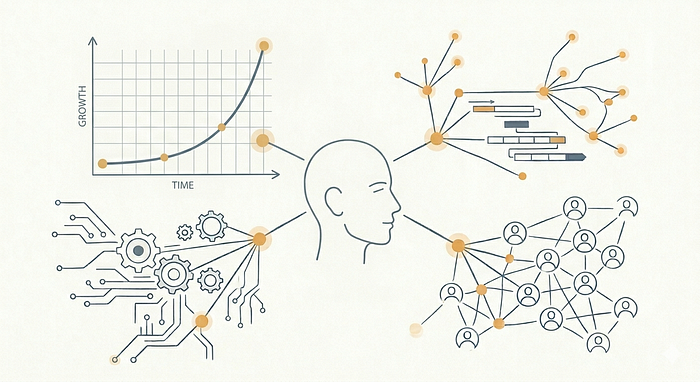
The profile I was describing isn’t a title. It’s a posture. People who hold the whole picture. People who translate across disciplines without losing the thread. People who’ve accumulated enough context, knowledge and insight to know how the pieces fit and where they break.
I said PMs. I should have said translators, connectors, system thinkers.
The gap-fill builder isn’t a job description. It’s a way of seeing and asking the right questions.
Sol doesn’t code at the level of an engineer. But he speaks every language fluently enough to move between them, and he knows where the product starts to drift from the customer. Five exits. That’s what that looks like in practice.
Drob has spent a career in design and design systems, working at the layer where visual language becomes product structure becomes user experience. His comment wasn’t “this applies to design too.” It was structural recognition. Same unlock, different discipline.
Allen’s framing was what stayed with me most. He’s seen what it looks like when the wrong AI incentives get rewarded. Token usage. Output volume. But what he named as the counter to that was taste and discernment, still the edge. Still what separates tools that move real value from tools that just produce output. That didn’t come from a PM. It came from someone who can see the whole system and what quality actually looks like.
What does a connector do ?
Only about 34% of companies are actually transforming with AI, according to Deloitte. The rest are optimizing inside old workflows. The difference, from where I sit, isn’t which tools they’re using. It’s whether someone in the room can see across layers.
The connector is the person who can do that. And AI doesn’t just accommodate that person. It amplifies them specifically, because directing AI across layers requires someone who can see all the layers.
Here’s what makes a connector. They hold the whole picture, product and customer and technical and market, all at once, without collapsing it into any single discipline’s frame. They translate across teams without losing the thread of what the thing is supposed to do. And they’ve built up accumulated context over years, the kind of judgment AI can run against but can’t manufacture.
That last part is the one nobody is talking about. The connector doesn’t just build faster with AI. They keep sight of the problem and the customer. They’re the one in the room asking “but is this the right problem?” and “who is this actually for?” when everyone else is excited about the output.
That’s not a soft skill. That’s the judgment no tool replaces.
Here’s the honest question underneath all of this. How many times this week did you ask AI for the answer because thinking it through felt slow? That’s outsourcing the thinking before you’ve done THE thinking. The connector doesn’t make that trade.
AI is a multiplier. But it multiplies in whatever direction you’re already pointing. Point it at the right problem and it compounds. Point it at the wrong problem and it gets you there faster. The craft isn’t using the tools. The craft is knowing which problem deserves them.
Superpowers can get you lost very quickly. The connector (you) are the compass.
The profile compounds.
Not because connectors are smarter. Because the work of directing AI well requires someone who can see the full context and who hasn’t outsourced the thinking that makes the direction worth anything.
This is the risk about deferring judgment (or intelligence even). The risk isn’t that AI does the work. The risk is that it becomes the thinking, not just the execution. The connector is the person who never makes that trade off. Not because they’re disciplined about it in an abstract sense. Because they built careers where the judgment was the whole point — what they brought to the table. That doesn’t stop being true because the tools got faster.
If anything, it becomes more true.
Speed reveals the gap between someone who knows what they’re looking for and someone who doesn’t.
If Article #1 made you think “that’s me, but I’m not a PM” — you were right. You never needed the title.
Sol proved that in one comment. Drob proved it from the design side. Allen proved it from inside one of the largest software companies in the world. The thesis wasn’t wrong. It was just too narrow.
The connector profile was always valuable. AI just made it visible.
This is the third in a series of observations I’m writing as I build. Article #1 was about the Gap-Fill Builder. Article #2 was about Progressive Trust. More coming.
Upcoming: What the connector actually does differently.
Also published on Medium ↗