AI Cannot Get Six People in a Room to Align
Building compressed. Then analysis compressed. Then everyone showed up with their own prototype, and the room got harder.
Last month I published a working guide with Felix von Kunhardt about product discovery in the AI era. It ran a bit long, but we wanted to ensure we capture our entire view and approach in completion for others to leverage. Four phases, a diagram, a field-test checklist, and an honest admission at the end that neither of us had run the whole loop end to end on one team just yet.
Somewhere in the middle of the guide, we dropped this line from Anthropic’s Amol Avasare via Lenny Rachitsky’s podcast, and we kept going:
The one thing AI cannot do is get six people in a room to align.
We quoted it, agreed with it, and then spent the rest of the piece on the rest of the guide.
However, this is one of the most important sentences in it. This article is about just that sentence.
What actually got compressed
The short version of A Working Guide to Product Discovery in the AI Era, and I am not going to re-argue it here.
Building got cheap. The engineering friction that used to filter the backlog, the pushback that said we cannot do that, it takes too long, I have ten other things, was quietly doing the work of prioritization for free. AI removed that friction. It did not remove the underlying constraint though, which was always real customer value.
What has become clearer to me since, is that building was only the first thing to compress. The analysis went too. A product manager can now vet a market alone, run the investigation that used to take a team and a three week research request, absorb enough engineering context to know what is genuinely hard or possible, ingest a design system and hold to it, and put a working version in front of someone by Friday.
So both halves of the individual craft got faster. The “Making” and the “knowing”.
What didn’t get compressed
Agreement itself.
Now that you can have a working prototype on a Thursday. You will still need three weeks to get five people to a decision they will stand behind on a Monday morning when you present the prototype.
Getting the right people in a room in the first place takes time. Drawing out the objection nobody has said out loud yet, which is almost never the objection being argued. Finding the version everyone can actually live with, as opposed to the version that wins. Maybe even a duplicate or alternate prototype from someone in the room. Then making the call, and owning it when it turns out wrong.
No tool has touched any of that. I do not think one is coming, and I say that as someone who has spent two years building tools for himself. This is also where you will see the army of one, or company of one idea actually being far easier and faster on execution.
It actually got harder
Here is the part that actually got even more complicated.
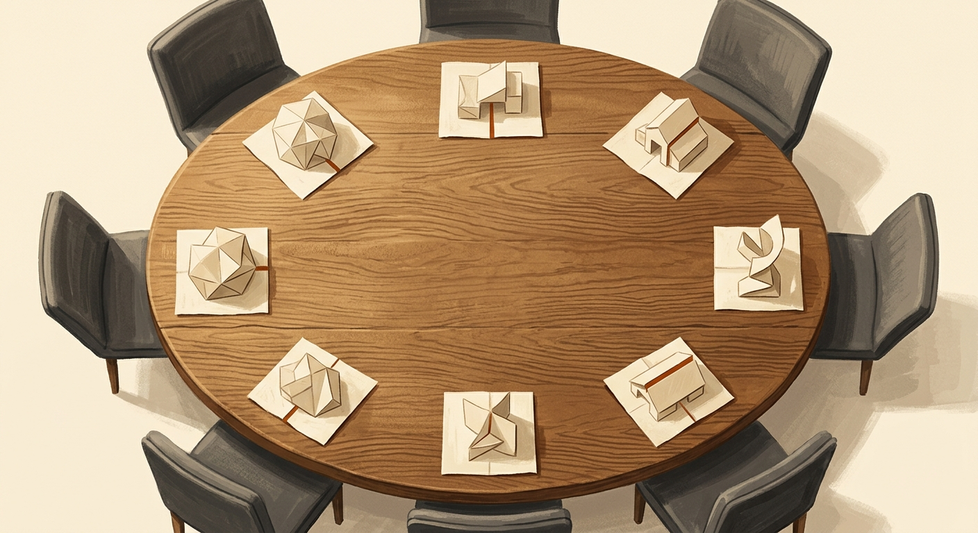
The old room had one artifact in it, and an argument about that artifact. The new room has six (or more), because everyone came in having built their own over the weekend, with their own evidence attached. And likely all diverging or different, competing even.
The attachment scales with what that artifact cost you to make. That used to be useful, because almost nobody had absorbed the cost. Now everyone has had the cost. Six people walk in already invested in their “thing”, each holding something that works, works and looks good, each with a demo.
Now, the disagreement is no longer about what we should build. It is about whose working thing we are going to abandon and which working thing we pick. In fact, it might make the choice even more difficult - it is like picking paint colors in the store, and you can’t figure out which shade of “eggshell white” you want.
That is a much more difficult room than the one I spent 20+ years in, and nothing in the tooling helps you here.
The senior half
Put the pieces together and the entire shape of the job has fundamentally changed.
The tools absorbed the parts of product management that were expensive, mundane or annoying even. However, what is left are the parts that already were hard. The Judgment about what deserves the effort. And driving towards agreement among people who did not start out agreeing.
For much of the “pre-AI” years that was what a senior product person was actually for, and it was maybe half the job. Today, in the AI product workflow - its the bulk of it, the hardest part of the job.
Getting people to agree, making tough choices, deciding what not to do, picking what to do and ensuring it aligns with your product strategy, goals and objectives.
That is the new job.
I spent the last two years re-learning this by building myself, and honing that skill. The much harder thing to build was “the room”.
Also published on Medium ↗